Four tiers. One clear queue.
Every asset carries a live risk score. Priority turns it into an action tier — automatically, every day.
Scheduled
8 - 11
Within the PM window.
Medium-risk assets serviced to plan. Deferring one in favour of a Critical job is defensible — and on record.
Critical
18 - 20
Act now.
Life-safety and life-support assets at maximum risk — ventilators, fire pumps, a lift with a safety fault.Deferral needs written justification and documented alternative cover.
High
12 - 17
Schedule urgently.
High-risk therapeutic, laboratory and building-services assets. Any deferral is logged and timestamped for the audit trail.
Plannable
1 - 7
Plan and batch.
Low-risk items grouped into efficient rounds. Still justified, still documented — just not first.
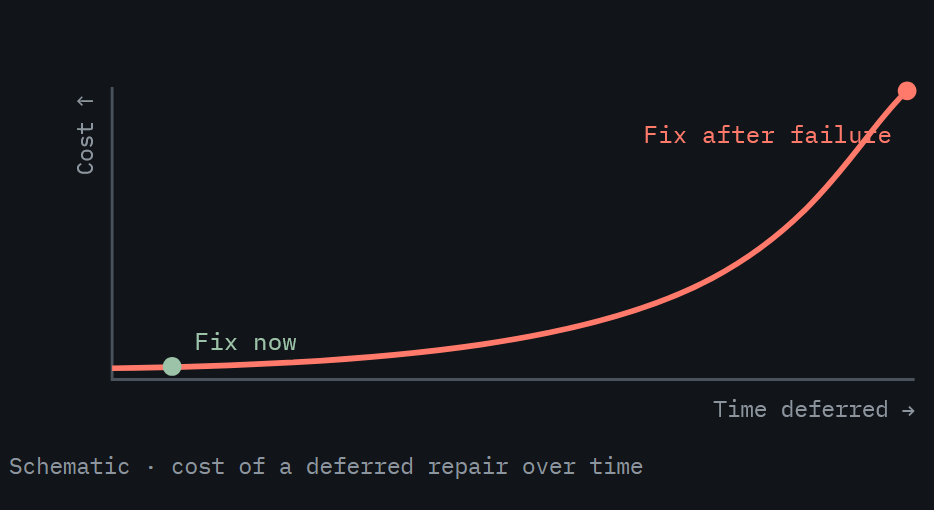
The budget will never cover everything — and deferred maintenance grows at exponential cost. That's exactly why priority isn't optional.
-
35%
of US hospitals made an emergency repair after deferring maintenance~18%
higher average cost when the work was done as an emergency79%
had less than half of their deferred-maintenance funding requests approved
Source: ASHE / HFM Hospital Construction Survey 2022 · Hospital Operations Survey 2024
-
More assets, more tickets — and the same money and headcount as last year. Worse, a repair put off doesn't stay the same size — a small fault left waiting becomes a breakdown, a replacement, an incident. The only question is whether a limited budget goes to the failure that would hurt most, or to whoever asked loudest.
Priority spends your budget on risk — not on noise.
Triage, borrowed from the emergency room.
An emergency department doesn't treat patients in order of arrival. It assesses severity, scores it, and sends scarce hands where they prevent the most harm. Priority applies the same discipline to your work orders, using the Equipment Triage methodology.
Every asset and hazard gets an OSHA-aligned risk assessment — what can go wrong, how likely, how severe — following DOSH's HIRARC approach. Medical devices add the Fennigkoh-Smith score.
Risk scores recalculate automatically — every asset, every day — as work orders open, close or go overdue. No spreadsheets, no pre-audit scoring sessions.
Work orders rank by the risk of what they fix, not by when they arrived. A new Critical ticket moves to the front of the queue on its own.
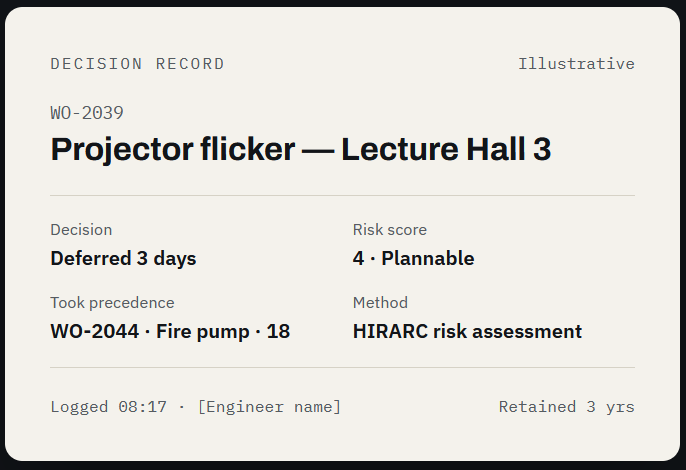
Every ranking, deferral and override is timestamped against the score that produced it. The audit trail writes itself.
Your engineers stay in charge. They set the parameters, read the scores and override the ranking when judgement demands it — and the override goes on record too. Priority doesn't replace expertise. It makes it defensible.
One method. Three kinds of facility.
Every asset and hazard gets an OSHA aligned risk assessment — what can go wrong, how likely, how severe — following DOSH's HIRARC approach. Medical devices add the FennigkohSmith score.
- Ventilators and infusion pumps
- Medical gases and operating theatres
- Imaging and laboratory analysers
Risk scores recalculate automatically — every asset, every day — as work orders open, close or go overdue. No spreadsheets, no pre-audit scoring sessions.
- Fume hoods and lab safety systems
- Lifts, lecture theatres and hostels
- Workshops and plant rooms
Work orders rank by the risk of what they fix,
not by when they arrived. A new Critical ticket moves to the front
of the queue on its own.
- Fire protection and pumps
- Lifts and escalators
- Chillers, switchgear and AHUs
When the investigator asks why it waited, answer with a number.
In Malaysia, the OSHA (Amendment) Act 2022 makes risk assessment an explicit employer duty and raises the personal liability of directors and managers. Accreditors are moving the same way: JCI's 8th Edition expects documented, risk-based equipment decisions with three years of history.
- OSHA-aligned risk assessment (HIRARC) on every asset and hazard
- Timestamped rationale for every ranking, deferral and override
- Three-year history, ready for DOSH, JCI and MSQH
- Audit once — prove compliance across every accreditation
CWorks Priority CMMS decides what's next.
A generic CMMS is a logbook — it tells you what happened. Priority tells you what to do next, why, and what deferring it would mean.
Automatic daily scoring
Risk scores recalculated nightly across the full inventory from the latest work order and failure history.
Triage-ranked mobile work orders
Technicians get their jobs in risk order. Completion data flows straight back into the scoring engine.
Double Pareto analysis
Find the 20% of assets consuming most of your risk and budget — and build evidence-based replacement cases.
Risk Vectors Patent Pending PI20266635
Risk score plus work order trend locates each asset on the bathtub curve. Spot wear-out before failure — no sensors required.
Audit trail
Every triage decision stored with its methodology and timestamp — three years of history from day one.
Multi-accreditation
One system maps evidence to OSHA, JCI, MSQH, KARS, CBAHI, HAI Thailand and NABH at once.
Trusted across 130+ countries.
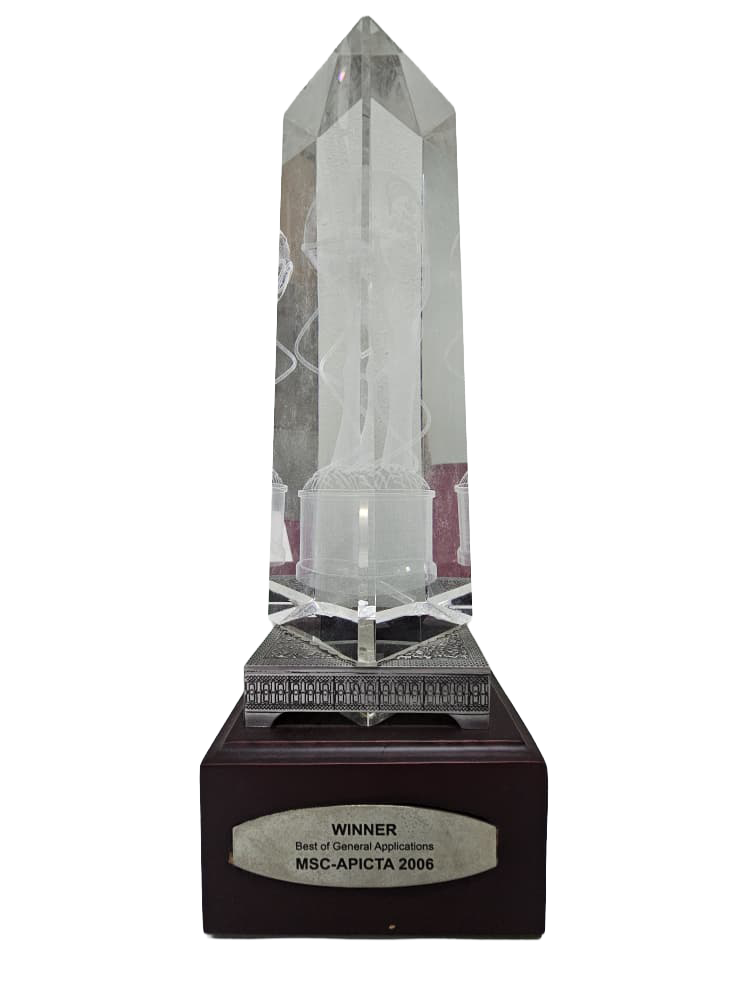
MSC-APICTA Best General Application
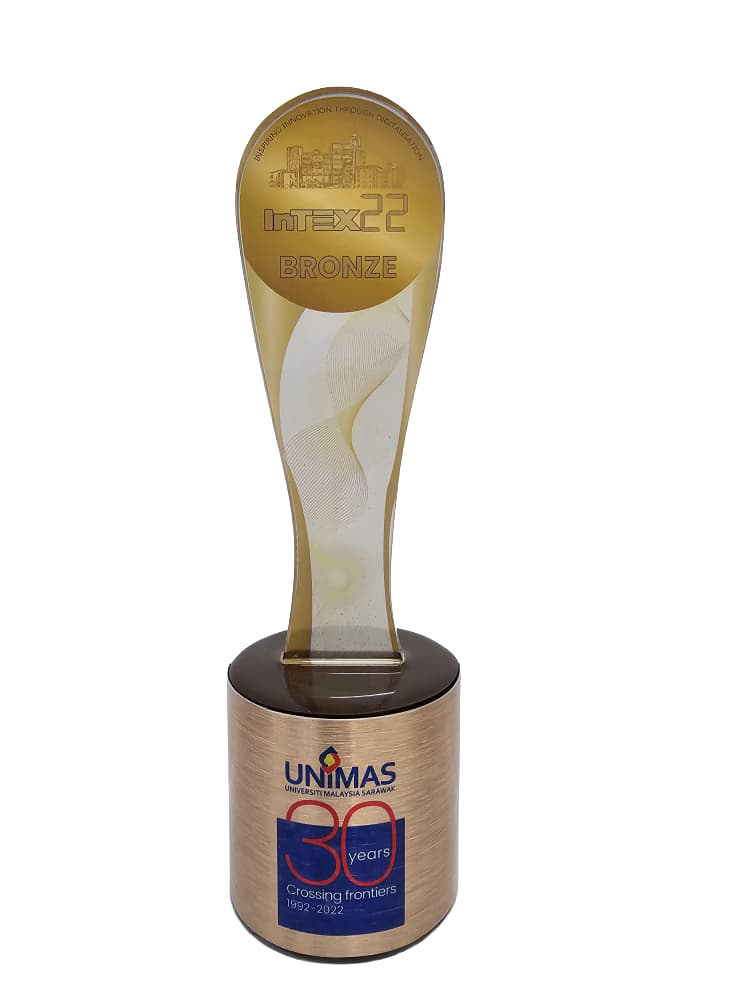
INTEX Bronze Medal
"We got a four instead of three year accreditation pass."
"This saves us the time of having to explain the issues."
"We found a ready and enthusiastic implementation team."
Priority isn't optional. Neither is the proof.
Book a 30-minute demo and see your own asset list ranked by risk — with the audit trail it produces from day one.
Book a Demo